

What is FND?
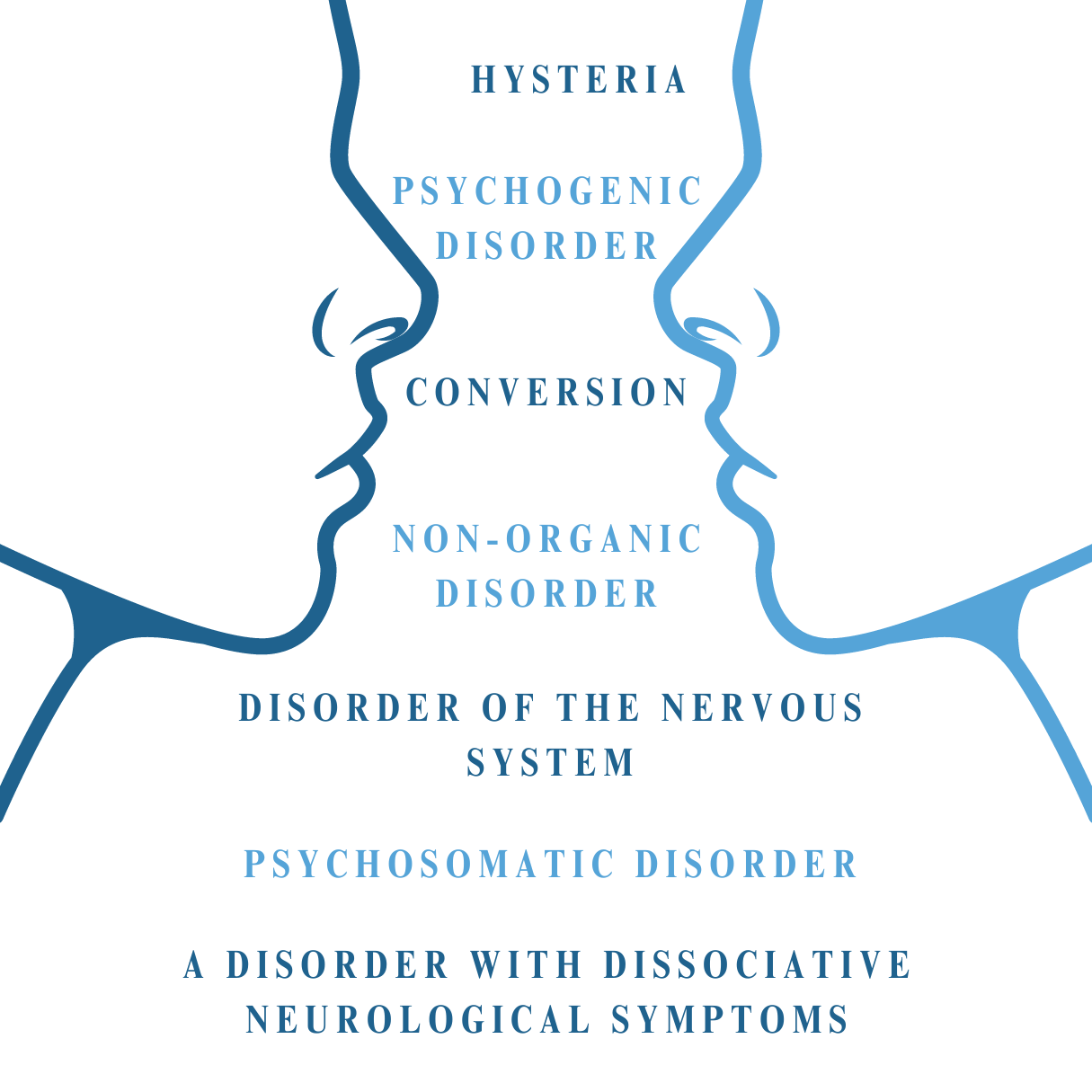
A functional neurological disorder ( FND) is a disorder affecting the functioning of the central nervous system. It is a common disorder and occurs in various forms. FND It results from a complex combination of biological, psychological, and social factors affecting the brain (Aybek and Perez, 2022; Bennett et al., 2021; Gilmour et al., 2020).
In the past, it has been referred to by numerous names, such as conversion disorder, psychogenic disorder, and even hysteria; however, over the past 10 years, it has experienced a clinical resurgence due to new findings in neuroscience (Bennet et al., 2021).
-
HYSTERIA
The term "Hysteria" comes from the Greek word 'hystera', which translates to 'womb'. It was first used in the 19th century to diagnose physical conditions in women. Over time, especially in the 20th century, with the influence of Sigmund Freud, Jean-Martin Charcot, and Janet, it shifted to describe mental health problems in women. Nowadays, 'hysteria' is no longer regarded as a valid medical diagnosis because it suggests that the person is overly emotional and irritable, among other characteristics.
-
PSYCHOSOMATIC DISORDER
The term psychosomatics originates from the Greek words 'psyche' meaning 'mind' and 'soma' meaning 'body'. A psychosomatic disorder is a condition that impacts both mental and physical health. It can be suggested that most disorders have a psychosomatic foundation, as mental aspects like stress can sometimes contribute to the onset of physical ailments. Psychosomatics highlights the interplay between bodily functions and mental well-being, showing how each can influence the other.
-
CONVERSION
Functional neurological disorder was long referred to as “Conversion Disorder” in the DSM-IV psychiatric diagnostic manual; but since 2022, the DSM-5 has changed the name to “Disorder with Functional Neurological Symptoms (Conversion Disorder),” which offers a more neutral and accurate designation FND. The term “conversion” originates from the works of Sigmund Freud, who used it to describe the transformation of psychological stress into physical symptoms.
-
NERVOUS SYSTEM DISORDER
A nervous system disorder indicates abnormal or impaired functioning of the nervous system. These include, among other things, infections, brain and spinal cord injuries, degenerative diseases such as Parkinson’s disease or Alzheimer’s disease, epilepsy, mental disorders, autoimmune diseases, etc. FND Patients do not exhibit damage to the nervous system, but rather difficulties the brain has in controlling the body.
-
DISORDER WITH DISSOCIATIVE NEUROLOGICAL SYMPTOMS
The International Classification of Diseases (ICD, 2019) defines dissociation as a separation or detachment of neurological functioning from normal consciousness. Dissociation is one of the mechanisms underlying functional neurological disorders, such as functional (dissociative) seizures.
-
NONORGANIC DISORDER
An organic disorder or disease manifests itself in measurable changes in organic or bodily systems, whereas a functional disorder manifests itself in changes in function that are not accompanied by measurable changes in organic or bodily systems. However, this does not mean that a functional disorder is “fake” simply because we cannot prove it with tests that measure changes in organic or bodily symptoms. In fact, neuroscientific research in recent years has confirmed different structural and functional brain activity in FND patients.
-
PSYCHOGENIC DISORDER
The concept implies that the disorder arises solely from psychological sources. While we acknowledge the influence of psychological risk factors, triggers, and factors that sustain the condition, it is inaccurate to equate causes with risk factors.
Is the cause of the disorder exclusively psychological?
FND is often interpreted as a mere 'psychological reaction' or 'a disorder resulting from stress or trauma'. These explanations do not take into account the broad spectrum and complexity of the disorder itself, but can also lead to psychological distress, manifested in patients' feelings of not being believed, alienation and stigmatisation (Cock and Edwards, 2018).
The problem with this explanation of the disorder is that it equates risk factors with the cause of the disorder itself (e.g. most FND patients have a history of a traumatic event, but it cannot be said that the cause of the FND is a past stressful life event).
A problem also arises when the routine communication of medical staff indirectly suggests that the cause is entirely psychogenic in nature—and thus trivial or even unfounded—thereby overlooking the fact that the diagnosis was made on the basis of positive clinical signs.
In the vast majority of patients, the disorder is triggered by a specific medical procedure, such as surgery, infections, or injuries. It is helpful to acknowledge the reality of this triggering factor to the patient while also explaining that the functional symptoms develop independently of damage to the nervous system following the trigger (Cock and Edwards, 2018).
Epidemiology

Functional symptoms are the second most common reason for seeing a neurologist, after headaches, and approximately 8,000 new cases are diagnosed each year in the United Kingdom.
Based on recent estimates, there could be approximately 1,600–3,200 Slovenians living with functional symptoms, with these figures representing the lower limit of prevalence.
It can occur at any age, but it disproportionately affects women (3:1), although the proportion of men diagnosed increases with age (Bennet et al., 2021).
Hardware vs Software analogy
In clinical practice, the metaphor of computer hardware is often used, where the hardware is intact (i.e. the brain), while the problem lies in the software (i.e. how the brain and body bilaterally receive and transmit signals). Underlying this analogy is the assumption that FND is a disruption of the mind-body connection and that further treatment will be aimed at reconnecting them, revealing the potential reversibility of the condition (Gilmour et al., 2020).


While this analogy is useful, it is a vague description of the disorder itself, as it does not include an explanation of the mechanisms, the factors that perpetuate the disorder and the next steps that will lead to a potential cure (Van der Hulst, 2023). As a result, the Pressure Cooker Model( PC Model) analogy is slowly gaining ground in practice, explaining all elements of the disorder in language that is understandable to the patient, while at the same time being visually easy to understand and remember. You can read more about the PC model here.
-
Aybek, S., and Perez, D. L. (2022). Diagnosis and management of functional neurological disorder. bmj, 376.
Bennett, K., Diamond, C., Hoeritzauer, I., Gardiner, P., McWhirter, L., Carson, A., and Stone, J. (2021). A practical review of functional neurological disorder (FND) for the general physician. Clinical Medicine, 21(1), 28.
Cock, H. R. and Edwards, M. J. (2018). Functional neurological disorders: acute presentations and management. Clinical medicine, 18(5), 414.
Gilmour, G. S., Nielsen, G., Teodoro, T., Yogarajah, M., Coebergh, J. A., Dilley, M. D., and Edwards, M. J. (2020). Management of functional neurological disorder. Journal of Neurology, 267, 2164-2172.
van der Hulst, E. J. (2023). A Clinician's Guide to Functional Neurological Disorder: A Practical Neuropsychological Approach. Routledge.